

Taxi Scams in Morocco: How to Avoid Overpaying
Updated: June 21, 2026 | Safety guide by Morocco Travel Experts
Direct answer: Navigating Moroccan taxi transport smoothly requires understanding the clear distinction between Petit and Grand taxis, insisting strictly on the use of the taximeter (compteur), utilizing local ride-hailing apps where applicable, or relying on pre-arranged private drivers to avoid predatory transit hubs.
While navigating Morocco is an incredible experience, transportation centers—such as airport exit terminals, train stations, and popular medina gates—are notorious for predatory overcharging schemes. Sourced from authentic experiences across global travel forums and Reddit communities, this guide equips you with exact strategies to keep your transit seamless and affordable.
Contents
Overview
According to extensive community reports on subreddits like r/Morocco and r/travel, urban taxi transportation is one of the most frustrating pain points for first-time visitors. The core mechanism of the classic Moroccan taxi scam relies on exploiting a traveler’s lack of local knowledge regarding standard regional rates and mandatory legal requirements.
Unscrupulous operators frequently deploy various deceptive maneuvers: claiming the mechanical taximeter is fully “broken,” inflating flat-rate fees up to ten times the legal price during late hours, demanding unexpected baggage fees, or manipulating the nighttime tariff (“tarif de nuit”) prematurely during broad daylight. Knowing the operational limits of these vehicles stops overpaying immediately.
The “Broken” Meter
Drivers waiting outside train stations frequently tell tourists that the legal meter does not work, clearing the path to demand an inflated, arbitrary flat-rate fee at the end of your trip.
The Night-Tariff Trick
Moroccan law permits a 50% legal surcharge after dark (usually past 20:00 or 21:00 depending on the season). Shady operators often adjust the meter setting or demand this premium during mid-day hours.
The Hub Surcharge
Directly boarding a taxi waiting right outside airport customs or a main rail terminal guarantees premium markups. Walking just 100 meters down the street to flag a cruising car saves substantial cash.
Recommended Plan
Protecting your budget across major imperial cities like Marrakech, Casablanca, and Fes comes down to basic pre-travel preparation. Implement this protocol whenever using street hailing options:
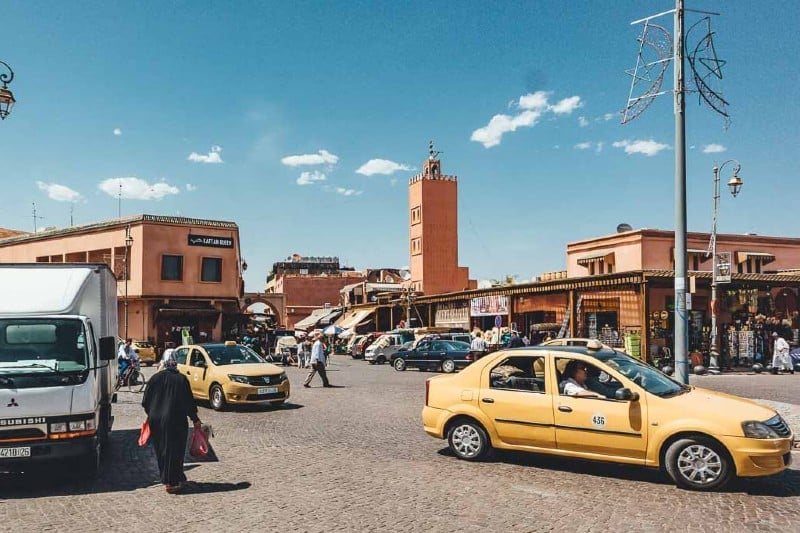
- Identify the correct vehicle class: Petit Taxis are color-coded by city (Red in Casablanca, Ocher/Beige in Marrakech, Light Blue in Fes). They are legally mandated to use meters and cannot carry more than 3 passengers total.
- Set the terms before entering: Never place your luggage in the trunk or sit inside the cabin until the driver explicitly agrees to use the meter. Simply state: “Compteur, s’il vous plaît” (Meter, please).
- Carry exact change in small coins: Drivers will frequently claim they possess absolutely no change for a 100 MAD or 200 MAD banknote, effectively forcing you to leave the massive remainder as an unintentional tip. Keep 5, 10, and 20 MAD denominations readily available.
- Utilize local ride-hailing software: Where local regulations allow, open digital apps to lock in fixed rates before entering a vehicle.
Practical Notes
Reddit travel discussions emphasize that tactical confidence and street awareness bypass transit scams completely. If a driver remains argumentative, walk away.
| The App Advantage | Community data from r/travel heavily suggests downloading InDrive or Heetch for city transit. While rides are arranged via smartphone, drivers operate on cash payment terms. Always check the application’s suggested price window before negotiating with normal cabs. |
|---|---|
| Airport Fixes | Major airports like Marrakech-Menara (RAK) now feature designated taxi booking kiosks with electronic fixed ticketing systems to counter historical price gouging. Look for these booths instead of talking to unauthorized drivers. |
| Sharing Rides | Do not be alarmed if a Petit Taxi driver stops to pick up random strangers along your path. This is standard local practice across Morocco; the driver keeps separate meter tracking for each passenger party. |
| The Ultimate Safe Pivot | For travelers managing dense baggage, traveling with children, or arriving past midnight, pre-booking a verified private airport transfer through your tour agency eliminates all transit stress. |
Route Table
| # | Stop or day | Planning note |
|---|---|---|
| 1 | Casablanca (CMN Airport to Downtown) | Avoid standard curbside touts. Legally, fixed-rate Grand Taxis to the city center should range around 300 MAD. Alternatively, catch the convenient ONCF airport train directly from the lower terminal level. |
| 2 | Marrakech (Gare de Marrakech to Medina) | Drivers waiting directly outside the platform gates routinely ask for 100–150 MAD. Walk past the direct parking perimeter to flag a moving ocher-colored Petit Taxi on the main boulevard; a metered trip to Jemaa el-Fnaa typically costs 15–25 MAD. |
| 3 | Fes (Fes-Ville Nouvelle to Old Medina) | Red light-blue Petit Taxis are generally very consistent with using their meters. A typical ride running from the modern train station straight to the historic Bab Boujloud gate hovers between 15 and 20 MAD on a standard day tariff. |
Booking Advice
When organizing a custom Morocco holiday, look at the grand scheme of your daily routes. If your journey involves multi-city transit, deep luggage transfers, or moving from isolated desert camps to deep medina riads, relying purely on municipal street taxis is highly inefficient.
What to confirm before requesting a quote
- Ensure all airport and railway station pickups are covered by dedicated, private professional drivers holding personalized name cards.
- Verify that your itinerary pricing explicitly covers all road tolls, airport parking fees, and evening transit premiums so there are no surprise cash requests.
- If traveling with young children, request pre-installed international safety seats—something local city taxis almost never provide.
Request a private Morocco plan
Morocco Travel Experts can adapt this guide into a route with private driver, local guides, riads, desert camp options and clear daily timing.
Useful Links and Sources
Morocco Travel Experts links
- Morocco Travel Experts.
- Morocco private tours.
- Contact Morocco Travel Experts.
- Custom Morocco itinerary.
- Morocco Travel Experts FAQ.
- 6 days Morocco Tour from Casablanca to Marrakech via Sahara.
- 6-Day Family Desert & Imperial Cities Tour from Marrakech to Casablanca.
- 8-Day Family Desert & Cities Tour from Casablanca to Marrakech.
- 9 days Tour from Marrakech to Casablanca.
- Casablanca to Marrakech.
External references
Images

Frequently Asked Questions
How can I verify if the meter is on the correct day or night tariff?
On standard Moroccan taximeters, the display shows numbers alongside the fare digits. Typically, a ‘1’ denotes the regular daytime rate, while a ‘2’ indicates the official nighttime tariff. Make sure the driver hasn’t engaged the night rate during the afternoon.
What should I do if a driver demands a massive cash fare after a trip concluded?
Remain completely calm. Hand over the accurate, fair price or the exact metered value, exit the car immediately, and walk directly toward a public venue or police officer. Mentioning the word ‘Police’ (‘Al-Chorta’) usually resolves the conflict instantly.
Is it legal for a Petit Taxi to take more than 3 people?
No. By strict Moroccan traffic law, Petit Taxis are capped at a maximum capacity of three passengers, regardless of age or physical size. If your travel party contains 4 or more individuals, you must legally split into two separate Petit Taxis or hail a single larger Grand Taxi.
Can I use traditional credit cards to pay for taxis in Moroccan cities?
No. Street-level Moroccan city taxis operate exclusively on cash payments in Moroccan Dirhams (MAD). Even when using app platforms like InDrive or Heetch, the transactions are predominantly settled using cash directly with the driver at your destination.