

Updated: June 21, 2026 | Safety guide by Morocco Travel Experts
Direct answer: Avoiding the henna scams in Marrakech requires knowing exactly how aggressive street vendors operate, steering clear of dangerous “black henna” chemical dyes, and redirecting your business to verified, transparent fair-trade shops in the medina.
While Marrakech is an incredibly vibrant destination filled with history, its central square, Jemaa el-Fnaa, hosts an aggressive circle of un-licensed street artists often referred to locally as “henna gangsters.” Preparing yourself prevents extortion and medical skin issues.
Contents
Overview
The infamous Marrakech henna scam typically Targets unsuspecting tourists—predominantly women and families—strolling through Jemaa el-Fnaa square. Unlicensed practitioners, often wearing full face-covering niqabs to hide their identities from tourist police, approach travelers under the pretense of a “free gift,” a welcoming gesture, or a quick demonstration.
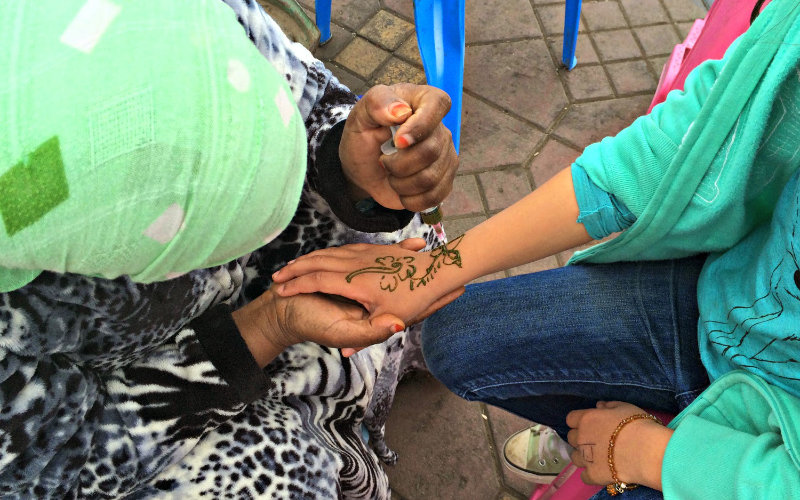
The trap closes when the vendor physically catches hold of a visitor’s arm or hand, instantly applying a crude design with a squeeze tube before the person can pull away. Once a few strokes are complete, the vendor demands outrageous prices ranging from 200 MAD to over 500 MAD (approx. $20 – $50 USD). If you object, they will cause a massive public scene, follow you aggressively, or even purposely smear the wet, staining ink over your skin and clothes.
The Hand-Grab Tactic
Street artists sit on plastic stools waiting for tourists to walk too close. They will grab your hand mid-air, say it is a “free trial,” and immediately paint a fast, sloppy pattern.
Extortion Prices
Standard traditional henna should cost between 30 and 100 MAD depending on complexity. Street scammers routinely extort up to 500 MAD from intimidated travelers.
Aggressive Backlash
If you refuse to pay their absurd demands, they rely on intimidation, public shouting, or smearing the paste to ruin your clothing and force submission.
Recommended Plan
You can seamlessly protect your personal safety and budget while still participating in this gorgeous, centuries-old Moroccan wedding custom. It all comes down to controlling where and how your body art is performed.
- Avoid the square completely for henna: Pass right through Jemaa el-Fnaa’s open street vendors without engaging, making prolonged eye contact, or stopping near their books of designs.
- Keep hands safely away: Keep your hands closed in your pockets or firmly holding your bag straps when navigating crowded sections of the square.
- Pre-book an authentic parlor: Schedule your sessions at structured, air-conditioned cafés or lounges inside the medina where prices are clearly listed on printed menus.
- Rely on your private travel network: Ask your tour driver or riad host to book a vetted, professional henna artist to visit your accommodations safely.
Practical Notes
The most critical risk regarding street henna is not the financial loss—it is the severe medical danger of toxic “Black Henna” mixtures.
| The Chemical Hazard | Street scammers regularly spike their paste with para-phenylenediamine (PPD), a highly toxic industrial textile and hair dye compound, combined with chemical accelerants like kerosene or gasoline to shorten drying times down to minutes. |
|---|---|
| Severe Skin Burns | PPD can produce violent contact dermatitis, chemical burns, painful fluid-filled blistering, and permanent skin scarring in the shape of the applied design. |
| Lifetime Allergies | Exposure to PPD can permanently sensitize your immune system. Future exposure to everyday items like dark clothing dyes, sunscreens, or salon hair color can spark severe, life-threatening allergic reactions years down the line. |
| How to Spot Natural Henna | Genuine natural henna paste is dark green or deep brown, carries a pleasant herbal, earthy, or tea-like smell, and must sit on the skin for hours, eventually coloring into an orange, brown, or reddish stain. It is NEVER completely black. |
Route Table
| # | Stop or day | Planning note |
|---|---|---|
| 1 | Jemaa el-Fnaa (Main Square) | A high-density area for scams. If a street artist grabs your hand, pull away firmly, yell a direct “No!” or “La, Shukran!” (Arabic for No, Thank You) and keep walking. If trapped, drop a 20 MAD bill on their stool and walk directly to the nearest police kiosk. | 2 | Marrakech Henna Art Cafe | Located just a brief walk away in Riad Zitoun Lakadim. Features explicit, transparent pricing menus starting from 50 MAD, utilizes 100% organic, laboratory-tested natural henna, and supports local non-profit initiatives. | 3 | Henna Louaya & Awraq Henné | Vetted, traditional indoor medina lounges providing premium organic Moroccan caftan dressing experiences and geometric, safe Saharan line art artfully applied over mint tea. |
Booking Advice
When booking standard tours or arranging custom Moroccan itineraries, make your comfort levels with street vendors transparently clear. Local travel teams can structurally build your day to bypass stressful tourist traps entirely while still connecting you with top-tier cultural encounters.
What to confirm before requesting a quote
- Ensure all medina walking tours utilize certified, officially badged guides who proactively shield your group from aggressive square vendors.
- Ask your agency to arrange an on-site private artisan evening at your luxury riad to provide family members and children with a relaxed, safe environment.
- Confirm with your travel coordinator that any suggested craft workshops or beauty excursions only employ verified, chemical-free organic ingredients.
Request a private Morocco plan
Morocco Travel Experts can adapt this guide into a route with private driver, local guides, riads, desert camp options and clear daily timing.
Useful Links and Sources
Morocco Travel Experts links
- Morocco Travel Experts.
- Morocco private tours.
- Contact Morocco Travel Experts.
- Custom Morocco itinerary.
- Morocco Travel Experts FAQ.
- 1-Day Family Atlas & Ait Benhaddou Tour from Marrakech to Ouarzazate.
- 1-Day Family Coastal Escape from Marrakech to Essaouira.
- 10-Day Family Morocco Highlights Tour from Marrakech to Tangier.
- 4-Day Family Desert Experience from Fes to Marrakech.
- 6 days Morocco Tour from Casablanca to Marrakech via Sahara.
External references
Images

Frequently Asked Questions
How do I identify a henna scam artist in Jemaa el-Fnaa?
They are generally un-badged women carrying laminated books of design clip-art, calling out to passing tourists in multiple languages, and leaning forward aggressively to make direct physical contact with your wrists or forearms.
What should I do if a scammer already applied the henna against my will?
Do not panic or enter an extended physical dispute. Pull away immediately, firmly offer a reasonable payment like 20 or 30 MAD for the small marking, mention the local tourist police (“Brigade Touristique”), and walk directly away to a public establishment or officer. Wash it off immediately with soap and water to minimize staining.
Why is “Black Henna” considered dangerous by health authorities?
There is no such thing as natural black henna. Black henna contains high concentrations of toxic PPD (para-phenylenediamine), a hair dye chemical that can generate severe chemical burns, open skin blistering, permanent physical scars, and lifelong allergies to cosmetic dyes.
Where can I safely get an authentic henna tattoo in Marrakech?
The safest locations are established, stationary brick-and-mortar operations inside the Medina, such as the Marrakech Henna Art Cafe, Henna Louaya, or Awraq Henné. These businesses feature transparent price structures, comfortable seating, and use 100% natural, chemical-free organic henna pastes mixed completely in-house.